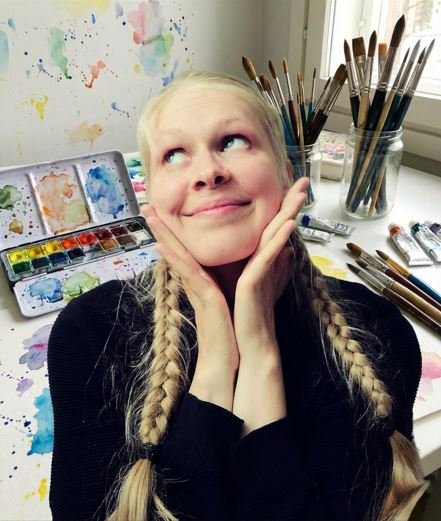
Jasmine Hintsala
Watercolor and digital artist, writer, comic book creator, entrepreneur based in Helsinki, Finland.

Biography
Jasmine Rosa Emilia HintsalaJasu
I, Jasmine Rosa Emilia Hintsala, commonly known as Jasu, was born in 1993, on the 16th of March, in a tiny village in Finland called Oulainen.
My family consists of 13 individuals: Mom, dad, five boys, and six girls. I grew up surrounded by people; there were many kids in my neighborhood, and I had plenty of cousins and other relatives whom I often saw.
Beginnings in Oulainen
A childhood filled with imagination, solitude, animals, forests, and the first instinct to draw everything that fascinated the heart.
I, Jasmine Rosa Emilia Hintsala, commonly known as Jasu, was born in 1993, on the 16th of March, in a tiny village in Finland called Oulainen. My family consists of 13 individuals: Mom, dad, five boys, and six girls. I grew up surrounded by people; there were many kids in my neighborhood, and I had plenty of cousins and other relatives whom I often saw. Even so, ever since I was a little kid, I always enjoyed playing alone. I used to (and still would) go explore the unknown environment on my own. Many times I'd rather leave the crowd of people to have my little adventures in solitude.
The forest was my favorite place: I would go there and spend hours imagining that I was the fastest horse in the whole entire universe. There were hunters constantly after me, trying to catch and imprison me, but I was the only horse they couldn't catch. Then, on other occasions, I turned into a tiger: I would be the most skilled hunter that had ever existed. The human-hunters never managed to track me but instead, I'd sneak behind them to give them the last surprise of their lives. Every time I was swimming, I turned into a dolphin or a seal, and when I was around 4 years old, I would take off all my clothes every day exactly at 6 pm because, naturally, animals didn't have clothes. Then I'd run like a dog all around the house and the yard, not using my hands at all when it was time to eat and drink. I remember my dad once asking me what I was going to become when I'd grow up. Without hesitation, I blurted out, “A tiger!” Dad laughed and asked me, “What do tigers do?” To this too, I had a clear answer: “They eat small children and the plump.”
Obviously, I was very passionate about animals, and when around the age of 7, my dad bought a VHS player, I would sit for hours watching different nature documentaries over and over again. My passion for animals and nature was always intertwined with my passion for drawing. And so, when I grabbed a pen, the papers would be filled with different animals. As my mom saw me watching a nature documentary I hadn't seen before, she'd often say something like this: “And now she's going to spend the next two weeks drawing those dolphins,” and that was exactly what happened. Seeing the animals on the screen always thrilled me to draw them. And so, I kept drawing, drawing, and drawing.
Learning to be seen
The first reactions from others, the hunger to fill every page with detail, and the refusal to create small worlds.
I distinctly recall a particular moment from when I had just started elementary school. I hadn't attended daycare or preschool, so going to elementary school at the age of seven marked the first time in my life that I'd spend my days away from home. One morning, I arrived at school very early, and to my surprise, one of my future best friends had done the same. The teacher, noticing our early arrival, invited us inside and provided us with paper, pencils, and crayons, encouraging us to draw.
Happily, I began drawing, creating a sizable grass field divided in two by a small stream on the left side of the paper. I then added horses grazing on the field. As I became completely immersed in my drawing, I suddenly heard a gasp from the girl sitting next to me: “Woaaah! That's so beautiful! You can draw sooo well! Can I have that drawing?” I still remember the feeling of surprise and confusion that her reaction caused me. I had always loved drawing, but it had never occurred to me that I was somehow “good at it.” I couldn't recall anyone at home commenting on my drawings, whether to praise or critique. I had simply been drawing because it was so much fun.
My mom used to hide all the drawing paper from me because I had a tendency to use up a huge pile of paper in just a couple of hours. This is why I started to draw on used envelopes and on the backs of paid bills that I found in the kitchen garbage bin. In the third grade, I got a new elementary school teacher, and for the next four years, we would occasionally argue about my drawing style. I had a wild imagination and always paid attention to details.
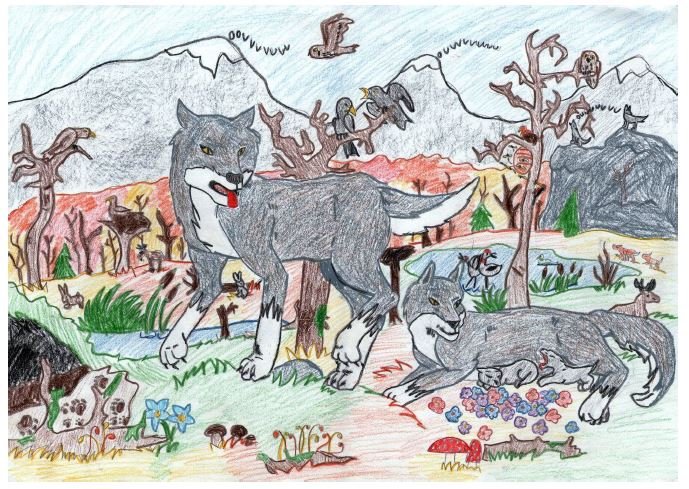
When given the task to draw “my day in a forest,” most of my classmates would create something that included themselves, a few trees, and perhaps a small additional element. In contrast, I would draw myself (probably riding some animal), various types of trees, bushes with differently colored berries, pine cones scattered on the ground, an anthill, and mushrooms. I would include tree stumps, stones of different sizes, some with moss and others with smiling faces. And of course, there were animals: a bear lurking behind one of the trees, a moose, a reindeer, a stag with enormous antlers, a hedgehog having a dinner with frogs beneath big rhubarb leaves. There were also one or two rabbits, a fox chasing a mouse, a snake, some lizards gathered together, a woodpecker diligently pecking a tree, squirrels annoyed by the noise, birds soaring across the sky, some perched on tree branches, an owl peeking from a hole in a tree, the sun and clouds in the sky, and perhaps even some rainy clouds and a rainbow. Wolves, lynx, and a weasel found their places in my drawing as well. Every animal that came to mind had to fit into the scene.
Looking back on those years, it's not surprising that my teacher occasionally lost his temper. However, I was always very fast at drawing, and even with all those details, I rarely left any works unfinished due to running out of time. Nevertheless, there were times when the teacher strictly forbade me from including so many details, as I seemed capable of continuing endlessly. Whenever he did this, I sought revenge by hastily drawing something that was far below my skill level. At home, I would tape several pieces of paper together to create one enormous canvas, and then I would begin drawing detail after detail as ideas continued to pop into my mind.
Biography highlight quote
Every animal that came to mind had to fit into the scene.
Skill, competition, and change
From being known as the one who could draw, to the slow change from joy into pressure and self-critique.
As elementary school progressed, I discovered more about my talent for drawing. Eventually, the entire school became aware of it. While drawing remained my favorite activity, it slowly introduced a new element into my life: competition. I had always been proficient in drawing, consistently the best among my peers, and I felt compelled to uphold that reputation. So, I continued drawing, relentlessly honing my skills. However, as high school commenced, the enthusiasm of my childhood years began to wane. I still enjoyed creating art, and I continued to excel, but the purpose of my art was gradually shifting away from pure enjoyment. I never felt good enough. Despite receiving numerous compliments, I couldn't bring myself to believe them. There was always something I perceived as wrong with my drawings, and I often fixated on their flaws.
Throughout my years in school, I excelled in most subjects, effortlessly earning excellent grades. Although I possessed skill, I lacked ambition. Memorizing what teachers expected us to remember and reproducing it on exam papers was a straightforward task for me. My grades remained exceptional even in subjects that didn't pique my interest. Yet, I never truly cared about my academic grades; my passion was solely focused on excelling in drawing.
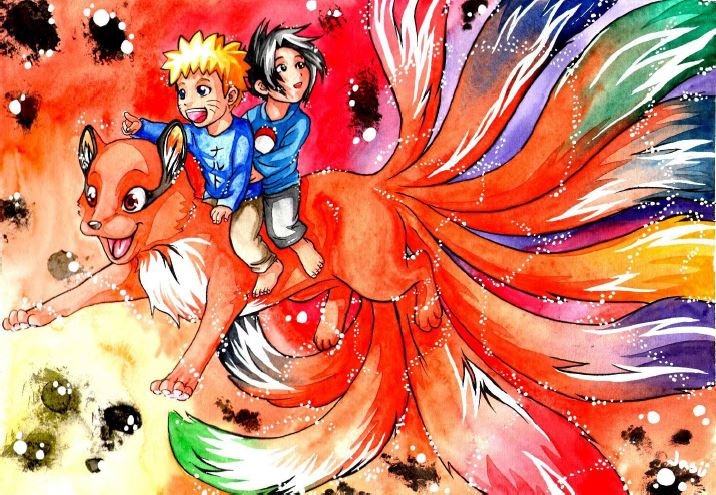
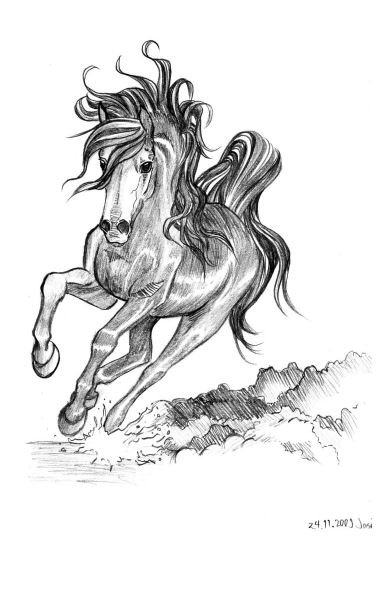
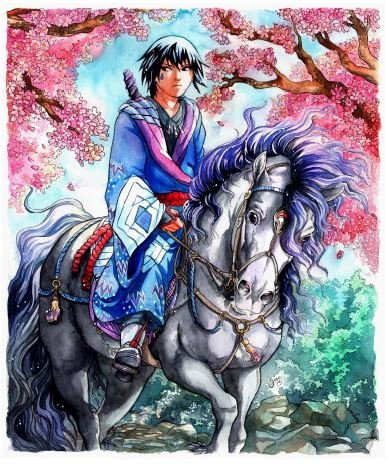
Up until the end of junior high school, my artwork primarily featured various animals, especially horses. Then, at the age of 16, I immersed myself in the world of manga and anime. They inspired me to start crafting comics with human characters. I had been intrigued by creating comics since elementary school, and for years, my greatest aspiration had been to become a professional comic artist. However, I hadn't previously had the patience to develop extensive comic pages. Additionally, encountering fellow artists my age, I felt inspired to learn the art of properly coloring my drawings, a practice I had rarely explored before.
Once a week, I attended an art club for teenagers, where I met an art teacher who became the first person to offer critique on my drawings. This was a new experience for me, particularly when it came to my art, as people had always showered me with compliments. Fueled by ambition and a desire to learn, I delved into digital art and experimented with various tools to enhance my technical skills.
The signature and the watercolor turn
The years when anatomy, personal identity, and watercolor became central to the work.
At the age of 16, my depictions of animals started to exhibit more realistic anatomy. Around the same time, my signature, “Jasü,” began to make its first appearances on my artworks. Rather than using a regular “u,” I opted for “ü” because it seemed to convey a smiling quality.
Throughout the years, art remained my favorite subject in school, but during art lessons, I never quite felt the same passion that I had when I was drawing at home. Even in the art club, with my favorite teacher present, I found myself merely sketching. It was only when I was on my own that I truly immersed myself in my work. I was eager to learn about anatomy, and for the first time in my life, I consciously made an effort to study the muscle and bone structures of humans and animals to make them appear natural in my drawings.
Upon starting high school, I discovered watercolors. I had disliked using them for most of my life, largely due to the poor-quality equipment we had at school. However, as I followed various artists on the internet, I noticed several of them creating stunning paintings with watercolors. This revelation convinced me that achieving a beautiful and detailed result with watercolors was indeed possible. At that point, I decided to learn how to paint with watercolors, primarily because they were much more affordable than the copic markers I desired but couldn't afford.
After purchasing my first set of watercolors, I remember trying them a few times and feeling frustrated because I couldn't achieve the results I wanted. Then one morning, I woke up with a sense of determination: today, I would succeed. And I did. Since that day, watercolors have become my favorite medium for coloring.
Art, struggle, and persistence
Admiration, imitation, self-doubt, online audiences, and the difficult years when art still remained a reason to continue.
Since elementary school, there had always been artists whom I admired, aspiring to be like them. My own artistic style never seemed good enough for me, leading me to repeatedly attempt to mimic their drawing and coloring styles. However, I often became frustrated when my efforts didn't yield the desired results. Ultimately, I would return to my own style, which I still wasn't content with. I regularly found new artists to admire, new styles to experiment with, and new disappointments to confront.
As I approached the age of 18, I became increasingly unhappy with myself and my art, which prompted me to withdraw. I continued drawing more than ever; it had become an obsession. However, my once cheerful depictions of humans and animals transformed into erotic gay drawings. The days when I would create something and eagerly share it with my family and friends were gone. I felt ashamed of my creations, so I only felt comfortable sharing them online, with a specific, like-minded audience, while hiding behind various online accounts. Despite becoming more skilled than ever, I still couldn't find true happiness in what I created.
At the age of 19, I moved to Rovaniemi to begin my studies at the University of Lapland with the goal of becoming an art teacher, even though I had little interest in teaching. I knew I loved creating art, but the prospect of being an art teacher didn't entice me at all. However, lacking knowledge of any other path to pursue, I proceeded with my studies, stumbling forward without a clear destination.
My sole desire was to improve in making art, to become better, but there was no defined endpoint. By the age of 21, with thousands of people from around the world following, encouraging, and complimenting my work online, I still couldn't find satisfaction. I created art solely to seek acceptance.
I continued to strive for improvement without ever feeling fulfilled. I couldn't stop drawing, even when it was tearing me apart. During the darkest times of my life, creating art provided me with a reason to keep going. Despite all the pain and suffering surrounding it, there was something about making art that carried a profound sense of purpose—a feeling I can't even begin to describe.
A life rebuilt through art
The transition from pain to purpose, and from uncertainty to Jasu Wonder World.
-
Age 19–21
Searching
I moved to Rovaniemi, studied art education, kept drawing, kept improving, and still struggled to feel fulfilled, even with growing encouragement online.
-
Age 22
Choosing
I made the permanent decision to leave my university studies and pursue the dream of becoming a full-time artist.
-
Today
Becoming
Jasu Wonder World became the place where I could sustain myself as an artist, believe in my creations again, and move forward with purpose.
The story continues
As my life began to regain its balance, so did my creations. Today, I have established my own company, Jasu Wonder World, to sustain myself as an artist. I made the permanent decision to leave my university studies at the age of 22 to pursue my dream. The inspiration for my career and business came from a close friend who helped me immensely, guiding me from the depths of my depression to a place of self-awareness and self-acceptance. Being the artist behind Jasu Wonder World has been my full-time occupation for over a year now. Once again, I can believe in myself and my creations, and I'm incredibly grateful for the life I have. However, this achievement has not been without its challenges. I've had to confront and overcome fears that have haunted me throughout my entire life. But now that I finally have a dream to pursue, I've made a promise to myself to do whatever it takes to achieve it.